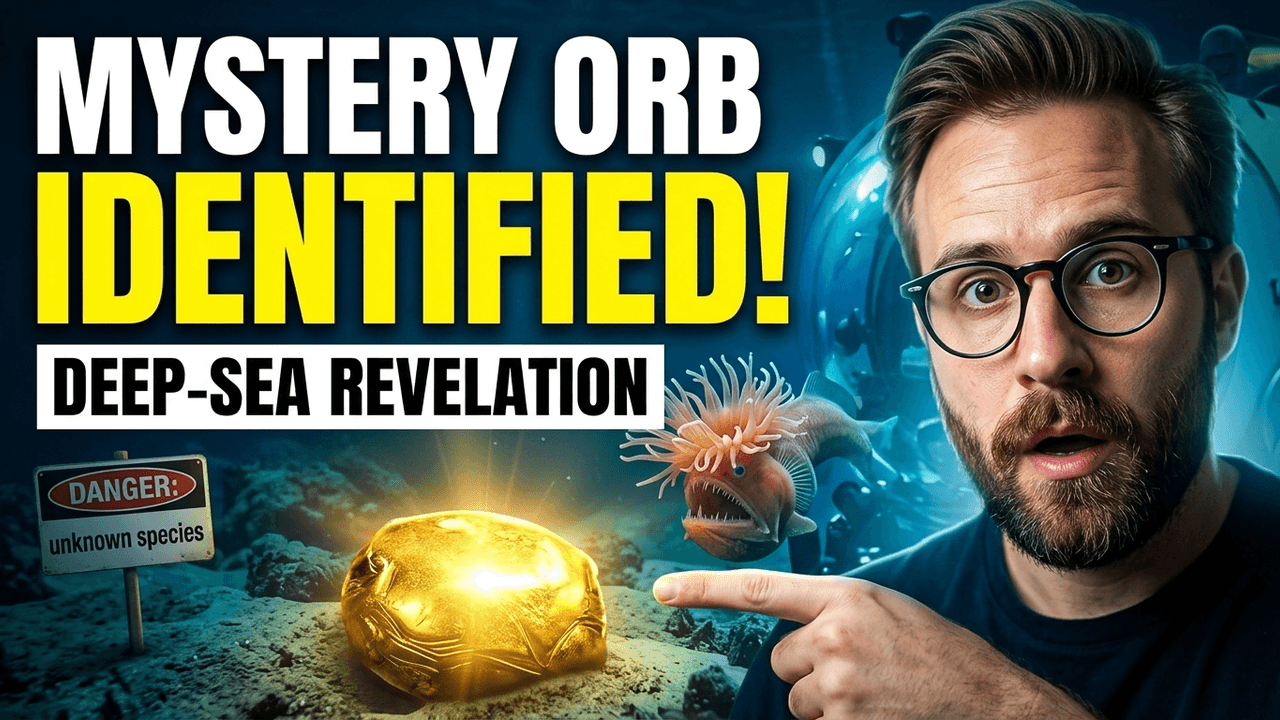
After years of speculation, scientists say the unusual object found off Alaska originates from an anemone-like organism.
By Ethan Caldwell
A baffling golden object discovered nearly two miles beneath the Pacific Ocean off Alaska has finally been identified, ending more than two years of speculation among scientists about its origins.
The unusual orb was first spotted in 2023 during a deep-sea expedition led by the National Oceanic and Atmospheric Administration (NOAA). Researchers aboard the exploration vessel Okeanos Explorer encountered the smooth, metallic-looking object firmly attached to a rock at a depth of about 3.2 kilometers. Despite retrieving it using a remotely operated vehicle, scientists were initially unable to determine what it was.
The discovery sparked widespread curiosity within the scientific community. Early guesses ranged from a marine egg to a sponge or even a colony of microorganisms. Its unusual texture and appearance left experts puzzled, with no clear anatomical features to guide identification.
Zoologist Allen Collins of the Smithsonian National Museum of Natural History later led efforts to analyze the object more closely. He described the initial confusion, noting that researchers struggled to identify basic biological characteristics such as a mouth or muscle structure, which might have indicated a known type of organism.
A breakthrough came when scientists examined the sample under a microscope. They identified nematocysts—specialized stinging cells that are a hallmark of the Cnidaria phylum, a large group of aquatic invertebrates that includes jellyfish, corals, and sea anemones. Further analysis revealed the presence of spirocysts, a specific type of stinging cell found only within a subgroup known as Hexacorallia.
Genetic testing provided another key piece of evidence. Researchers detected DNA not only from various microbes but also from an anemone-like species called Relicanthus daphneae, a relatively mysterious deep-sea organism.
That finding prompted collaboration with Estefanía Rodríguez, a marine invertebrate specialist at the American Museum of Natural History, who has extensively studied R. daphneae. She identified the material as a cuticle—a structure secreted by the organism to anchor itself securely to the seafloor. In other words, the golden orb was not the creature itself, but a biological structure it produced.
The findings, which have been posted on the bioRxiv preprint server and are yet to undergo peer review, offer a rare glimpse into the biology of deep-sea species that remain largely unexplored.
“Everyone was asking, ‘What is this thing?’” Collins said, recalling the confusion when the object was first discovered.
“The first step was to look for obvious anatomical features—something like a mouth or muscle tissue,” he explained. “But none of those were present, which made identification especially challenging.”
The resolution of this deep-sea mystery highlights both the complexity of ocean ecosystems and the limits of current scientific knowledge. As exploration technology improves, discoveries like this underscore how much remains unknown about life in Earth’s most remote environments.
This discovery is a reminder that even in an age of advanced science, the deep ocean continues to surprise us. What seemed like an unexplainable anomaly turned out to be part of a natural, if little-understood, process. It also shows how persistence and collaboration across disciplines can gradually unlock the secrets of the planet’s most inaccessible regions.
deep sea discovery, NOAA expedition, golden orb mystery, marine biology, Relicanthus daphneae, ocean research, Alaska waters, deep ocean creatures, cnidaria, sea anemone, underwater exploration, marine science, Smithsonian research, ocean mystery, bioRxiv study, aquatic invertebrates, deep sea expedition